

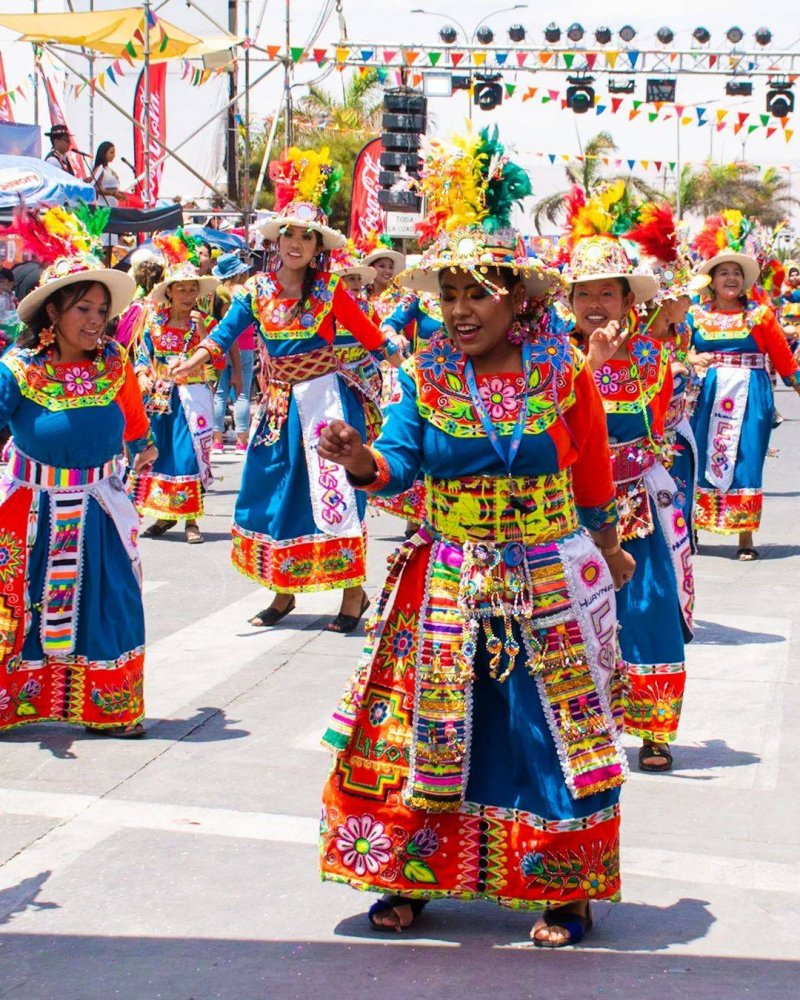
It is important to make a clear distinction between the folk dance known as Tinku and the ritual gathering that served as inspiration in the Norpotosina region.
Folkloric Tinku had its origins with the performance of the "Tinkus Tollkas" during the Carnival of Oruro in 1981. The band that accompanied the first presentation was "Los Kollas Aymaras," a respected institution that not only learned to play the songs and compilations but also contributed some original compositions. After the initial success of the "Tinkus Tollkas," more people wanted to join the dance, and two additional fraternities emerged: the "Tinkus Jairas" and the "Huajchas." From then on, folkloric Tinku expanded to La Paz, where it became part of the repertoire of folk dance groups, starting with the National Folkloric Ballet. However, in the city of Potosí, urban Tinku in the 1980s sometimes took on a burlesque and, at times, vulgar representation.
In its early stages, this new Tinku still maintained ties with the communities of the North Potosí cultural region, which includes the northern part of Potosí and parts of Oruro and Cochabamba. However, over time, the dance took its own course and acquired an increasingly urban identity, gaining acceptance among social sectors that had never before imagined participating in a dance considered "indigenous."
As the dance evolved, issues of discrimination dissipated, and it began to be perceived as a more inclusive cultural expression. Today, it enjoys great popularity among the youth, as it does not require significant economic resources and is appreciated for being a dynamic, energetic, and joyful dance.
Undoubtedly, strength plays a fundamental role in the construction of masculinity through dance, manifesting itself in "bold and powerful steps." This dance is inherently powerful and becomes an expression of masculine virility, sometimes even considered somewhat macho.
Interestingly, this same virility is what also attracts many young women, who, at least in their representation in the dance, often assume masculine roles, despite most of them wearing feminine attire. Furthermore, there is a trend towards greater similarity in clothing between men and women, where an increasing number of girls wear striped or woven scarves, which traditionally do not correspond to women's attire in the rural setting.
The folkloric clothing of the Tinku
The women's attire exhibits a certain fusion with elements of male clothing and aligns more with Modern Tinku than with traditional Tinku rooted in Potosí. The dance steps also incorporate elements of combat, unlike the traditional Tinku of Northern Potosí, where a white flag is used to ward off negative energies and vibrations in the context of the ritual.
While some Tinku dancers believe they are performing an indigenous dance and understanding indigenous values, it's crucial to note that all monographs of folkloric fraternities exclusively refer to the ritual Tinku of Northern Potosí. The urban folkloric Tinku currently represented maintains a barely perceptible link with the indigenous festivity and ritual. The fundamental connection lies mainly in the central theme of folk dance: the fight and its preparations. However, it is crucial to understand that the steps, music, choreography, and attire are products of mestizo and urban imagination projected onto the ritual context, often with little real contact with the latter.
Some dancers are very aware of this distinction. Overall, Tinku is considered more of a ritual than a folk dance and has undergone significant differentiation and diversification over time.
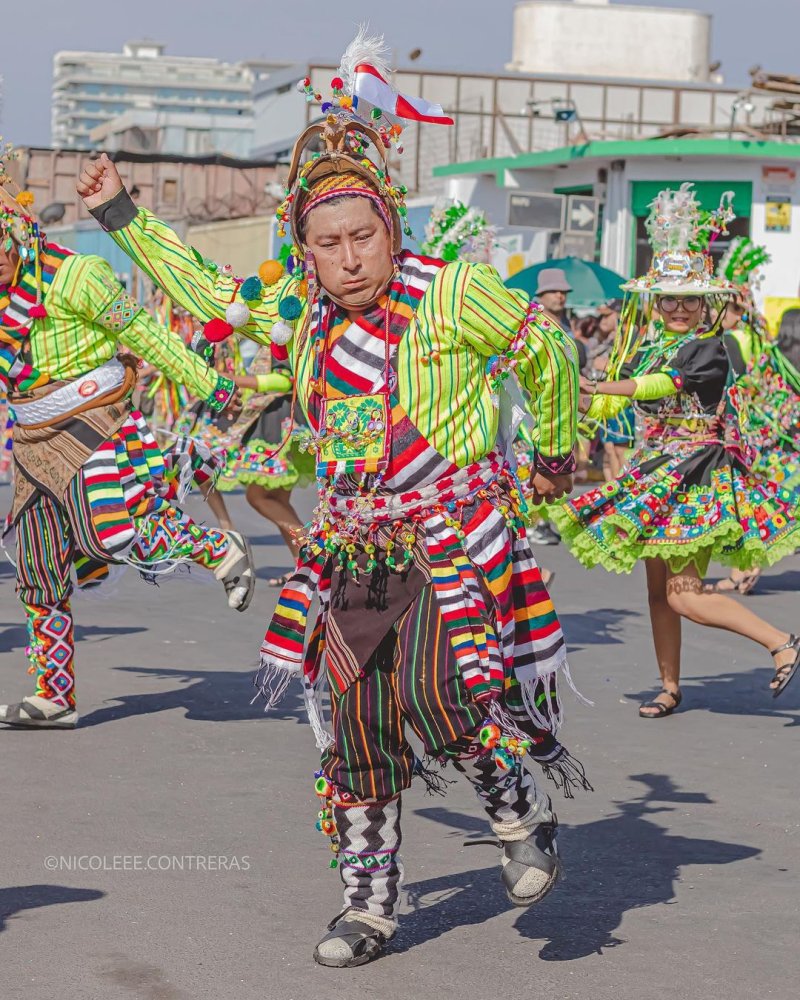
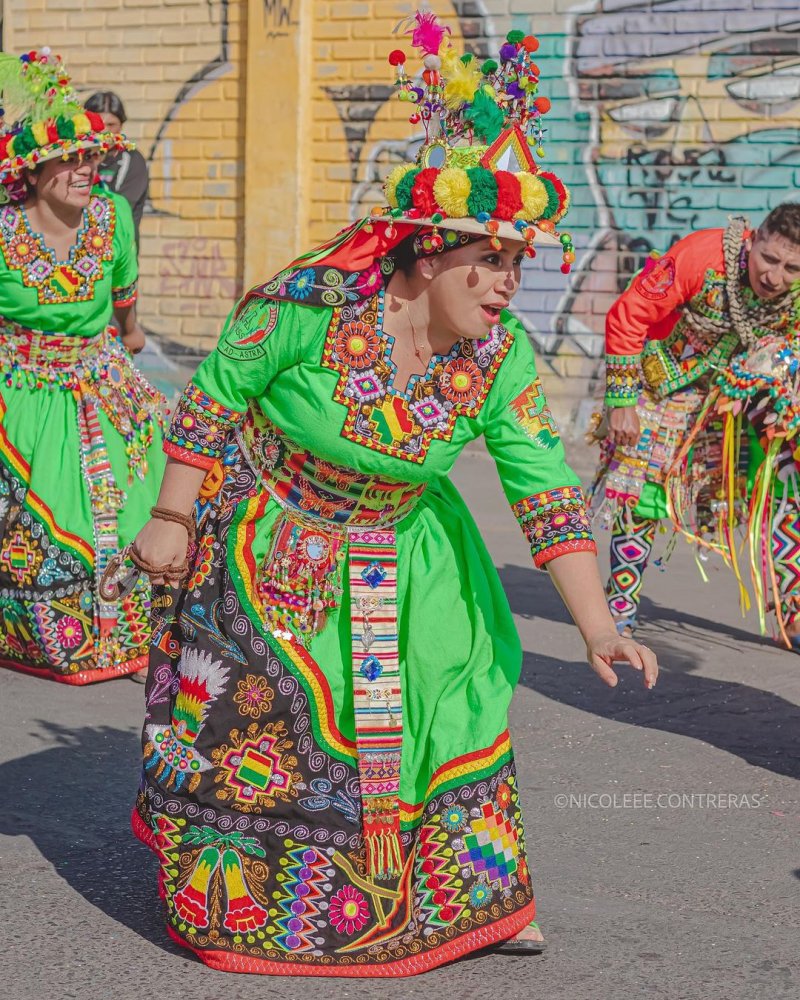
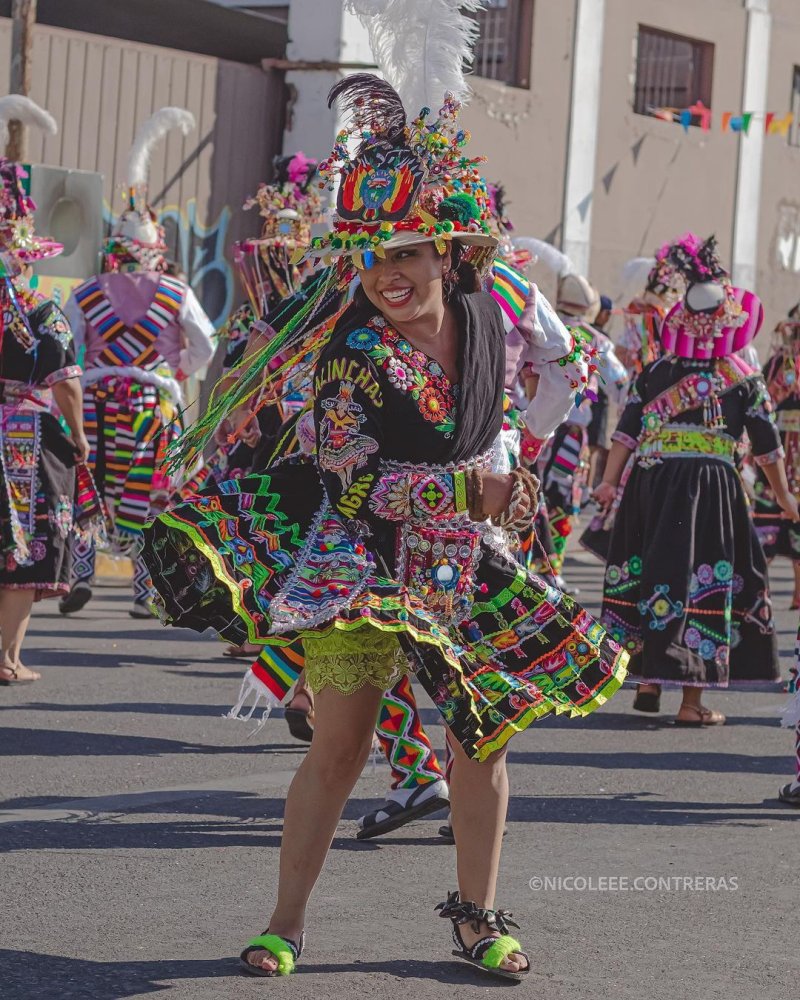
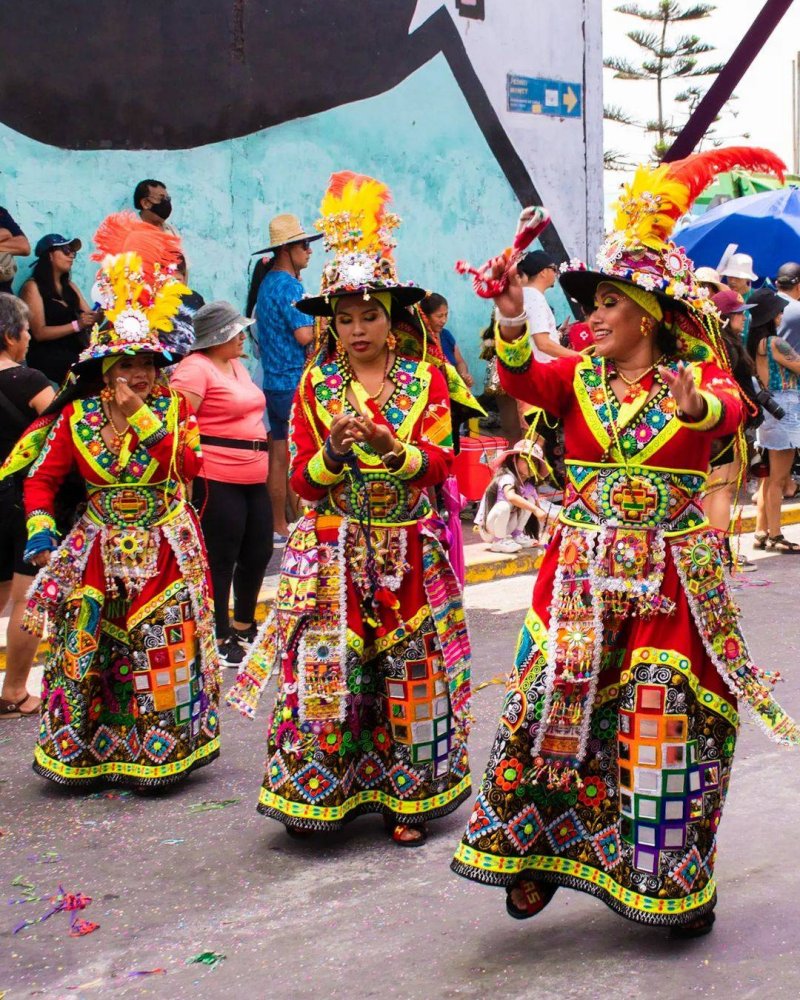
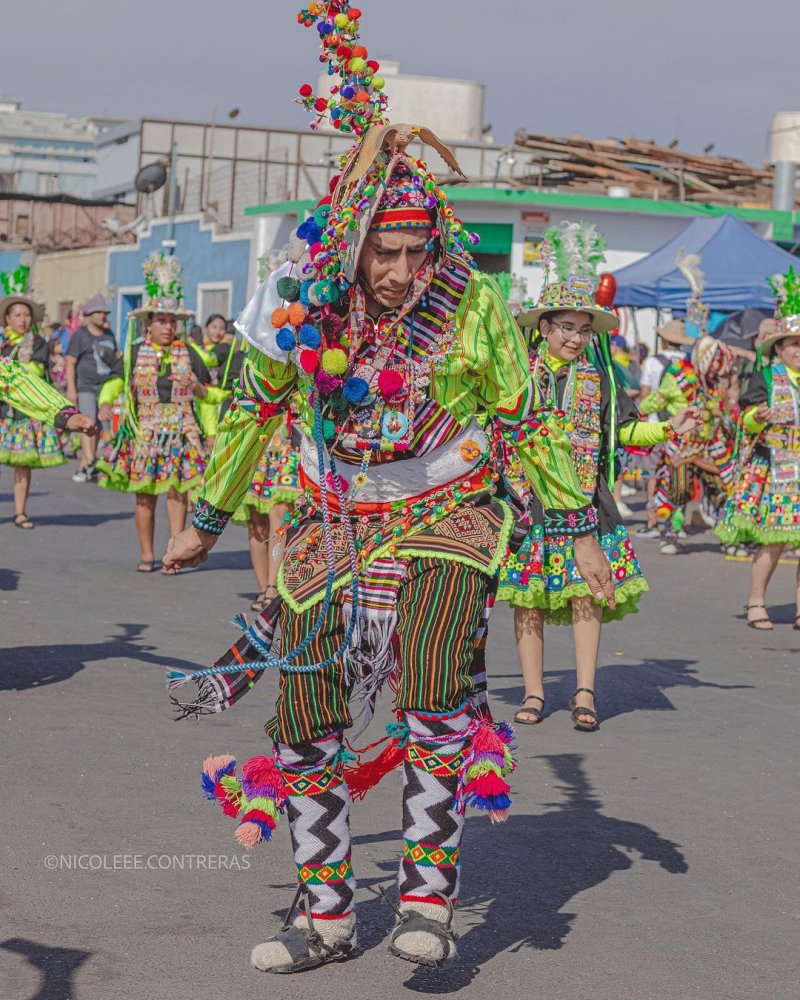
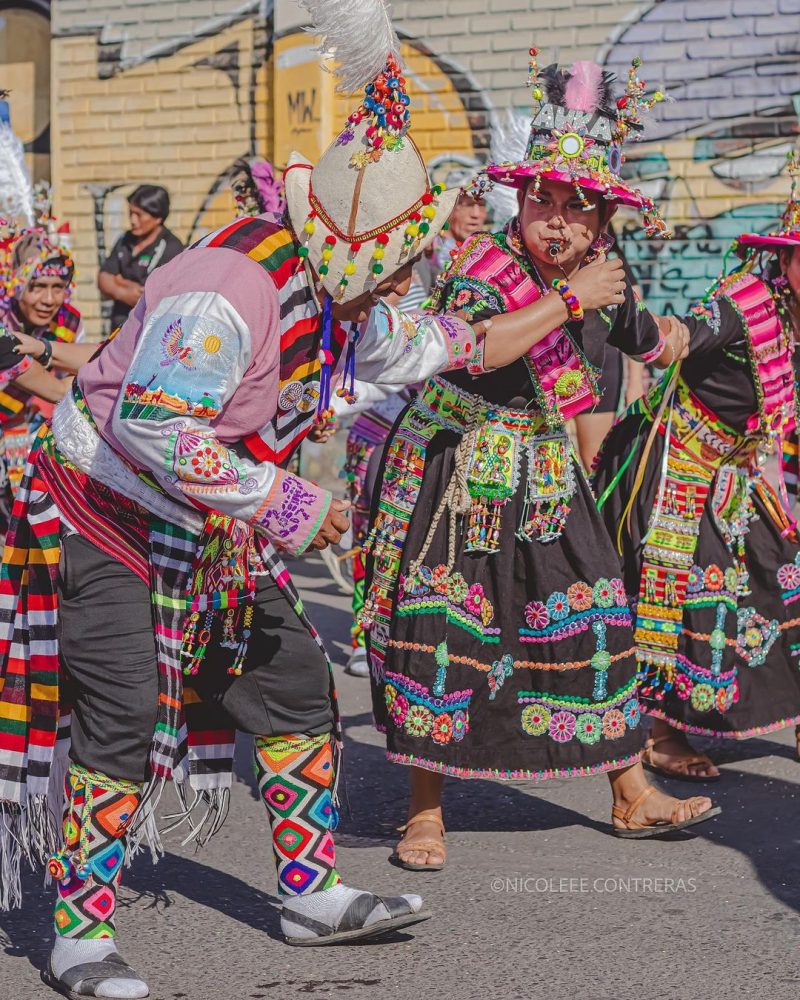
One aspect that has undergone significant changes in Tinku is the attire, especially for women. Nowadays, it is common to see women wearing long, brightly colored dresses that have a completely different cut than the traditional black almilla of Northern Potosí. These dresses are longer but less flared, and their embroidery differs considerably from the indigenous model. In addition, many dancers use a colored "trapito" as an apron, resembling the aqsu, a meticulously woven garment that folds into pleats and is placed on the back of the wearer. As for men's attire, it bears a closer resemblance to the Northern Potosino style, but both men and women have the custom of excessively decorating their hats with chicken feathers, which are also not part of the original attire.
The names of the dance steps are suggestive, with terms like "la moto," "warak'azo," "el gorila," or "el legislador," most of which refer to attack and violence preparations.
It is essential to highlight that Tinku involves a considerable amount of fighting. In the past, they used to perform demonstrations in avenues with a bit more space, where participants engaged in simulated battles. On some occasions, these confrontations became serious, with fatal accidents involving cuts and other injuries.
This group of dancers carries out a substantial part of the fight in their representation of Tinku, and this characteristic is highly appreciated by most people. They follow tradition and engage in authentic fights during the event, adding a distinctive and thrilling element to the dance.
New styles part of the evolution of this dance
A group that undoubtedly played a significant role in the development of the new urban style of Tinku is the Cultural Workshop "Tinkus Wistus de la Carrera de Economía" from the Universidad Mayor de San Andrés in La Paz. This group is highly active and participates not only in the University Entrance Parade in La Paz but also in the Carnival of Oruro, Gran Poder, and other folkloric festivities. The name of the group comes from "wist'u," which means "crooked" or "twisted," referring to the distinctive movements of this dance. Founded in 1992, this fraternity has stood out for its innovations arising from the idiosyncrasy and aesthetics of the elites in La Paz.
The initial members of this group did not have connections with indigenous rural roots. They were young people from well-off families, with educational levels comparable to those of their parents. Additionally, they shared physical characteristics such as a lighter complexion, light eyes, and considerable stature, making them stand out among the population of La Paz.
Despite some recent openness in the past years, the "Wistus" still maintain an elite image. This elite image is also reflected in their choreography, as the "Q'ara" Tinkus have radically modified the original Tinku dance, rapidly diversifying it.
The "Wistus" style has been so successful and accepted that some even speak of a new dance with the same name. In other words, there are groups that, by imitating this dance style, claim to be performing Wistus instead of Tinku. An important innovation introduced by the "Wistus" was the incorporation of mixed blocks in the 90s. This alteration reflects a certain perspective on gender roles and women's capabilities, leading to the creation of a unisex "warrior" style where both men and women perform the same steps and movements, completely breaking with the traditional "female" role that women used to play in the dance.
The fusion with male dance aims to represent strength and emphasize the active participation of women in the ritual, even involving blood sacrifices, which plays a fundamental role in this celebration.
Women execute their dance steps similarly to men, as it is a mixed dance in which they strive to match the movements equally. Most girls participating in this dance enjoy the dynamics of mixed blocks, finding it livelier and more fun. Additionally, they consider this form of representation to be more elegant and beautiful, especially during Carnivals.
Due to the preference of many urban young women to identify with a strong and untamed "warrior" image, the practice of mixed blocks has rapidly spread to other Tinku fraternities.
Currently, the majority of fraternities participate in mixed blocks with a single choreography and a unified rhythm. However, not all fraternities follow this trend, especially university fraternities, which tend to maintain a unique choreography. In general, most dance blocks have become mixed, reflecting a modernization in this tradition.
The names of the blocks often reference indigenous communities considered particularly formidable and untamed, such as "Laymes," "Jukumanis," and "Chayantacas." These names reinforce the youthful and aggressive image of the dance. It is important to mention that there are very few older people participating in Tinku, and if they do, they usually form part of a special row of Mama T’allas, Jilaqatas, or Second Majors, at least in Oruro. In La Paz, occasionally, there are "jesting" characters or blocks that imitate migrants from northern Potosí selling lemons in popular markets or on the streets. Some of the prominent Tinku fraternities in this city include Tinkus Huayna Lisos, Tinkus Jairas, Arco Iris Boliviano, Gente Nueva, and Jina Villamilistas.
Current clothing of the Tinku Dance
The attire for both men and women has undergone significant changes over time. The clothing worn in the Tinku of Northern Potosí differs considerably from what is observed today, encompassing variations in colors and designs.
Vestimenta actual de los hombres
For men, the traditional attire consists of a hat made from a combination of leather and wire, adorned with a feather. They wear "calzonas," which are trousers crafted from local wool, along with a vest or jacket made from the same material. To secure the calzonas, they use a two-colored scarf or "chumpi" wrapped around the waist. Additionally, they wear "sicas," which are woolen leg coverings, and "abarcas," sandals made from tire material or leather.
In the case of women, their attire includes a long dress made of "tocuyo" fabric, featuring wide sleeves. They also wear an "Ajsu," a kind of cloak placed at the back of the "almilla." The "reboso" is a dark-colored shawl with embroidery, while the "K’epi" consists of a woven cloth in which they carry their children or snacks. Additionally, they wear a hat made of sheep wool, which nowadays often includes mirrors, feathers of various colors, and "ojotas," a type of footwear similar to indigenous sandals or shoes.
These changes in attire reflect the evolution of culture and traditions over time.

Tinku choreography
In this context, the editorial La Patria provides a detailed explanation of the main characters. One of the prominent characters is the "Jilakata," who represents the highest authority of the "ayllu," a community formed by a set of families, lineages, or clans with shared rights and obligations. Alongside their partner, they form the power and unity known as "chacha warmi," meaning man-woman. This couple is considered responsible for the well-being of the community and the "wawaqallus," who are the community members. In the dance, the Jilakata leads the blocks of dancers or ayllus and is responsible for carrying a whistle to indicate changes in the choreography within the folkloric group.
Mama Jilakata and Mallku
The "Mama Jilakata" is the companion of the "mallku," and together, they represent the original authorities of the "marka," which is the town and lands of an "ayllu" or indigenous community. Their responsibility is to ensure the well-being of the "wawaqallus." In the dance, she acts as a prominent figure, and her attire differs from that of the "imillas." In some cases, she may also carry a whistle and take on the role of the block leader, in charge of looking after all the "imillas wawas" (young girls).
Las Imillas
The "imillas" represent young, unmarried women in the community. Due to their age, they are considered "wawas" and are part of the dance groups. They hold a status equal to that of the "lloqallas" and have the possibility of advancing in the hierarchy based on their seniority and responsibility.
Los Lloqallas
"The 'lloqallas' represent unmarried men in the communities who are either not married or have not completed military service. Like the 'imillas,' they are part of the dance groups and can ascend in the hierarchy based on their seniority and responsibility."
La yunta or El toro
"La Yunta" or "El Toro" symbolizes the relationship between man and nature, which constitutes the main economic support for peasant families. This character is personified by two usually robust dancers and is led by another dancer. Its horns are often adorned with streamers during the carnival, highlighting its importance in the dance and its connection to rural life.
The music accompanying this dance is performed using various instruments, mainly sikus (panpipes) and bombos (drums). According to the Institute of Research and Training in Tourism and the Environment (IICSTUR) at the Tourism Department of UMSA, the music of Julas Julas is a fundamental part of the festivity. In this music, the aerophones, known as sikus, take center stage and are played distinctively, without the presence of bombos or drums. While the musicians play, the Imilla Wawas, holding a white flag known as wiphala, lead the group.
In addition to the sikus, other musical elements such as the charango, foot stomping (zapateo), and Quechua verses are incorporated, although they do not necessarily follow the current rhythm of the Tinku dance. However, these elements are interwoven in the overall choreographic expression.
Tinku, considered a ritual of combat, is closely related to the main flutes of the Julas Julas. It represents a meeting between two opponents, accompanied by symbolic bloodshed, possibly aiming to promote the fertility of the land, ensuring a good harvest, and consequently, the continuity of the human race. Ultimately, Tinku is a ritual dedicated to the veneration of Pachamama, Mother Earth.
In the following video, you can appreciate the original music of Tinku in a celebration accompanying the Tinku ritual, which has endured over time. In this celebration, various communities from the province of Chayanta travel to the town of Macha. For this occasion, they wear exclusive attire reserved only for this festivity. This attire includes ojotas or uyutas (sandals made from rubber tires), colorful long stockings, fabric pants and vests, colorful belts, embroidered chulos (typical hats), and monteras (helmets made of raw cowhide adorned with suri feathers).
Upon arriving in the town, participants enter the central square trotting and spinning counterclockwise. During this process, they play traditional instruments such as the jula jula aerophone and the charango chordophone, as well as small guitars or qhunqhuta (names used in this celebration). These instruments are played exclusively on this date. While enjoying the celebration, they also consume corn chicha, sing in Quechua, and perform a style of foot stomping unique to this festivity.
Modern Tinku music
The original music of Tinku underwent a significant transformation when folk groups began interpreting it. This new interpretation was characterized by being much more lively and dance-friendly, blending traditional Andean elements with contemporary influences. In this musical context, zampoñas (panpipes) play a fundamental role in creating a festive and energetic atmosphere.
Contemporary Tinku music often incorporates a variety of instruments such as drums, guitars, charangos, and other string instruments that accompany the zampoñas. These instruments contribute to creating a vibrant rhythm and a solid harmonic foundation that complements the melody of the zampoñas. Tinku songs typically have marked and fast-paced rhythms that invite movement and dance.
The lyrics of Tinku songs often address themes related to romantic and emotional experiences, including romance, heartbreak, jealousy, and passions. The voices of the singers, mostly young and often male, blend with the sound of the zampoñas and other instruments, creating a sonic experience that evokes both strength and celebration.
Today, numerous folk groups excel in interpreting the Tonada in the style of Tinku. This genre was so successful in the 90s that groups from that era incorporated their own distinctive style. Here are some of their most successful songs.
Tinku is not Peruvian or Chilean
The western region of Bolivia, bordering Peru and Chile to the west, has witnessed the emergence of altered versions of the Tinku dance. Peru is a notable example of how it has systematically appropriated Bolivian dances, and, surprisingly, has attempted to present its own version of the origins of these dances. Unfortunately, the copied versions from Peru are often a poor imitation and, to make matters worse, they frequently dance the Tinku to compositions by Bolivian artists. Over the years, Peruvians have modified the attire to give it a completely different look.
It is important to highlight that Bolivian dances are a valuable and significant part of their culture. While it is understandable that people worldwide are attracted to them and wish to participate in their expression, appropriating these dances inappropriately is a serious cultural disrespect. Traditional Bolivian dances are an important heritage that must be preserved and respected. The authenticity and cultural significance should be acknowledged and valued.


